
RCM Liquid Flow Meters
RCM Series 7000 and RCM Series 8000
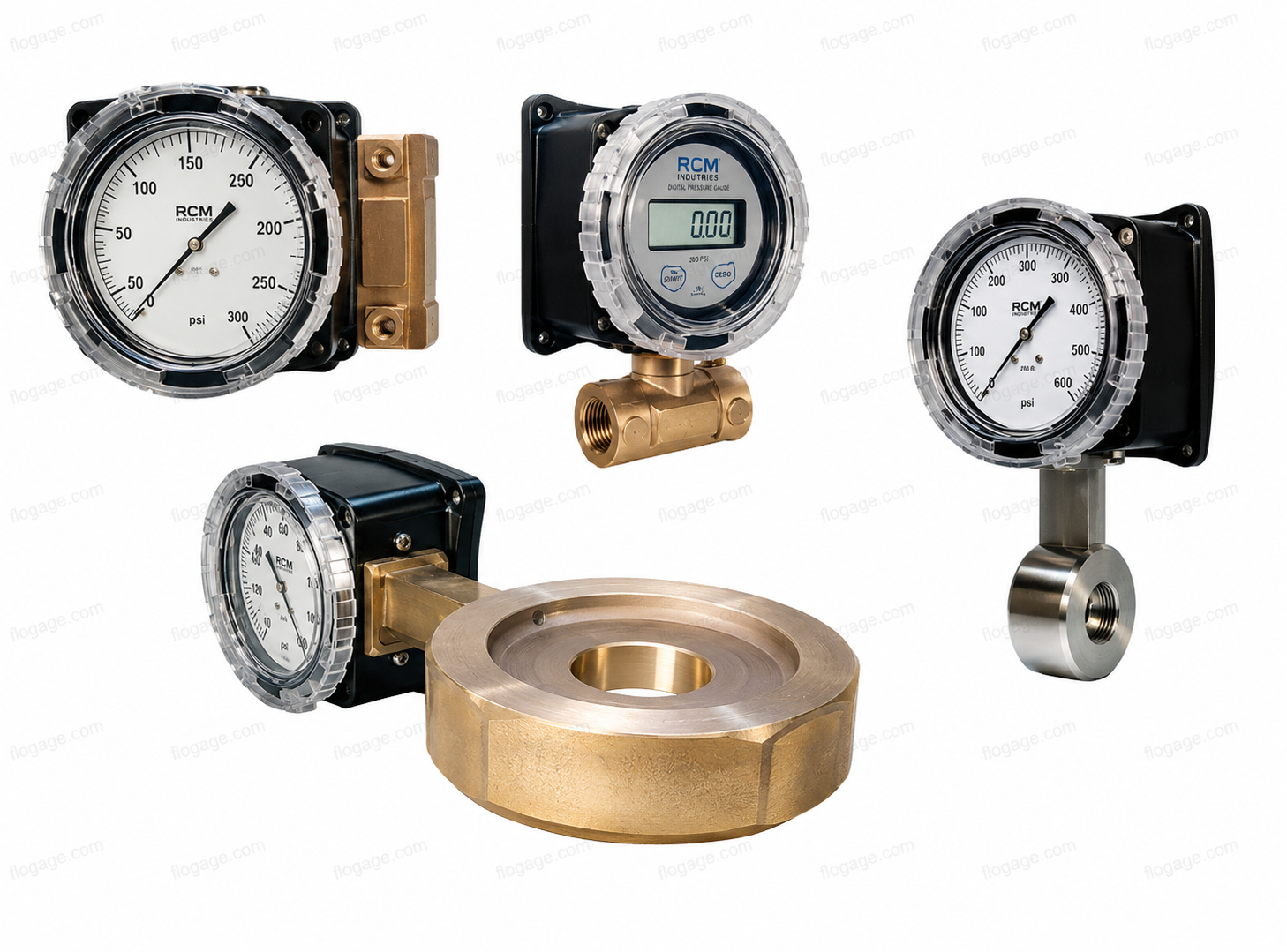
RCM liquid flow meters have been developed for industrial applications where durability and reliability are important considerations in the monitoring of flow. The Flo-Gage™ operates on a classic differential pressure (ΔP) principle, similar to an orifice-plate meter but fully integrated for simplicity and reliability.
The Flo-Gage has accuracy for most industrial processes and is particularly suited for applications where compactness, low cost, minimal maintenance and resistance to accidental damage are important factors.
RCM liquid flow meters are suitable for potable and non-potable water, irrigation water, glycol-water mixtures, fuel oils, lubricating oils, gasoline and many other low and medium viscosity liquids (maximum viscosity 500 centipoise).
- Meters available in Bronze, Monel or 316SS
- Threaded Connections (Series 7000): 1/4″ to 3″ NPT or BSP
- Wafer Style (Series 8000): 1/2″ to 8″
- Liquid flow ranges: 4 GPH (15 l/h) in 1/2″ to 3000 GPM (1200 l/m) in 8″
Standard Features
- Sturdy in-line metal construction to withstand piping stresses without breaking.
- Black on white dial — won't crack, glaze or become hard to read with age.
- Expanded 3.5″ (90mm) 270° analog dial for reading at a glance.
- Suitable for use with both opaque and clear fluids.
- Measures 6:1 range with ±3% F.S. Accuracy.
- Dial and case factory configured for quick installation — but easily field re-configured if needed.
- Liquid flow ranges from 4 GPH (15 l/h) in 1/2″ meter to 3000 GPM (1200 l/m) in 8″ meter.
Typical Applications
HVAC
Chilled water and hot water loop monitoring in commercial buildings
Chemical Processing
Solvent, acid, and reagent flow measurement in batch processes
Food & Beverage
Cooling water, glycol, and process liquid monitoring
Pharmaceutical
Purified water (PW) and WFI distribution systems
Oil & Gas
Lube oil, hydraulic fluid, and fuel oil monitoring
Water Treatment
Chemical dosing and process water flow verification
Manufacturing
Coolant flow monitoring on CNC machines and heat exchangers
Power Generation
Cooling water and condensate return monitoring
Specifications
| Specification | Standard | Optional |
|---|---|---|
| Series | Series 7000 (FNPT threaded) | Series 8000 (Wafer, 150/300 class flanges) |
| Housing | UV Stabilized Polycarbonate | Aluminum |
| Body | Bronze | Monel / 316SS |
| Bellows | Bronze | Monel / 316SS / Inconel |
| Seals | Buna N | Viton / EPR / Teflon |
| Crystal | Polycarbonate | Glass |
| Gear Movement | Bronze | 316SS |
| Accuracy | ±3% F.S. | ±3% F.S. |
| Repeatability | ±1% F.S. | ±1% F.S. |
| Maximum Pressure | 180 psig (12.6 kg/cm²) | 400 psig (28.1 kg/cm²) |
| Minimum Pressure | 10 psig (0.67 kg/cm²) | 10 psig (0.67 kg/cm²) |
| Maximum Temperature | 212°F (100°C) | 350°F (177°C) |
| Minimum Temperature | -30°F (-34°C) | -80°F (-62°C) |
Services Not Recommended
- Resins, paints or monomers which can form solid deposits in the piping system.
- "Super-solvents" which attack most available elastomers.
- Sulfuric acid in any concentration.
- Foams which tend to have inconsistent densities.
- Toxic substances requiring hermetically sealed enclosures.
- Fluids with viscosity above 500 centipoise.
- Pumping systems using piston pumps which produce non-steady flow conditions.
- Gravity-fed systems having less head than the pressure loss across the meter at normal operating conditions.
Option: Liquid Ammonia Service
Liquid ammonia is used in industrial cooling systems, fertilizer and NOx emissions. Liquid ammonia service flow meters are constructed of stainless steel with EPR seals and a gasketed case, developed for industrial applications where durability and reliability are important considerations.
Installation Guidelines
- Straight Pipe: Provide 10 diameters of straight pipe in front of meter.
- Valves: Install control valves or solenoid valves downstream of meter if possible.
- Minimum Flow: The minimum flow rate which can be read is approximately 15% of full scale.
- Best Accuracy: Select a flow rate which will permit normal operation in the upper half of the meter scale.
Enhance Your Meter
Add a Signal Output or Switch
Reed Switch
Options -1S2 & -2S2
Trigger alarms, shut down pumps, or activate equipment at a set flow point. One or two independently adjustable SPDT setpoints. CSA/ATEX intrinsically safe versions available for hazardous locations.
4–20 mA Transmitter
Options W, W2, W3, RW3 & more
Send a live flow signal to your PLC, DCS, or recorder. Choose from 4-wire linear (W), 2-wire differential pressure (W2/W3), HART variants (-1), or digital display with Modbus (RW3-4).
Liquid Flow Meter FAQ
Common questions about selecting, installing, and specifying RCM Flo-Gage liquid flow meters.
Application & Fluid Compatibility
Sizing & Selection
Installation & Piping
Options & Accessories
Have a liquid application question not covered here?
Our engineering team is available Mon–Fri, 8:30am–4:30pm EST.